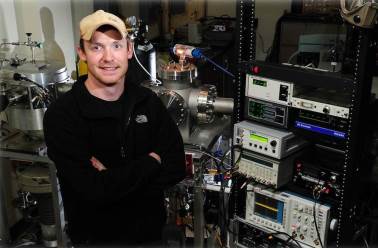










Gregory Tschumper
Associate Professor
|
Contact Information
Office: 105 Coulter Hall
Phone: 662-915-5331
Email: tschumpr AT olemiss.edu
Educational and Professional Background
B.S., Winona State University, 1995 Ph.D., University of Georgia, 1999 Postdoctoral Fellow, ETH Zurich, Switzerland, 1999-2000
Postdoctoral Fellow, Emory University, 2000-2001
Assistant Professor, University of Mississippi, 2001-2007
Associate Professor, University of Mississippi, 2007-2013
Professor, University of Mississippi, 2013-present
Research Interests: physical chemistry,
theoretical chemistry,
computational chemistry,
hydrogen bonding,
van der Waals forces |
Group Webpage
http://quantum.chem.olemiss.edu
Research Summary
My research group is devoted to obtaining answers and insight to important chemical problems in essentially every area of chemistry, especially biological and organic chemistry, through theory and computation rather than experimentation. Chemistry is largely governed by the physics of electrons. Because the quantum mechanical Schrodinger Equation, HΨ = EΨ, properly describes the physics of small objects such as electrons, its solutions can provide insight into the chemistry of atoms and molecules. Due to the complexity of the underlying mathematics, such solutions can only be obtained with substantial computational resources.
Of particular interest are weak chemical interactions
(hydrogen bonding, van der Waals forces, pi-type
interactions, etc.) that play a vital role in a host
of chemical, physical, and biological processes.
Using extremely accurate electronic structure
techniques, we probe the details of the underlying
physics behind these interactions. We are also
developing new computational methods that can
reliably describe weak chemical interactions in
large chemical or biochemical systems.
Recent Publications
G.S. Tschumper in,
Reviews in Computational Chemistry, K.B. Lipkowitz and T.R. Cundari, Eds., VCH, New York,
26, 39-90 (2009). Reliable Electronic Structure Computations for Weak Noncovalent Interactions.
D. M. Bates and G. S. Tschumper,
J. Phys. Chem. A.,
113, 3427-3708 (2009).
CCSD(T) Complete Basis Set Limit Relative Energies for Low-Lying Water Hexamer Structures.
DOI LinkD. M. Bates, J. A. Anderson, P. Oloyede and G. S. Tschumper.
Phys. Chem. Chem. Phys.,
10, 2775-2779 (2008). Probing the effects of
heterogeneity on delocalized π...π interaction energies.
DOI LinkA.M. ElSohly and G.S. Tschumper.
Int. J. Quantum. Chem.,
109, 91-96 (2009). Comparison of polarization consistent and correlation consistent basis sets for noncovalent interactions.
DOI LinkK.L. Copeland, J.A. Anderson, A.R. Farley, J.R. Cox and G.S. Tschumper,
J. Phys. Chem. B.,
112, 14291-14295 (2008).
Probing Phenylalanine/Adenine π-Stacking Interactions in Protein Complexes with Explicitly Correlated and CCSD(T) Computations.
DOI LinkB. W. Hopkins, A. M. ElSohly, and G. S. Tschumper.
Phys. Chem. Chem. Phys., 9, 1550-1558 (2007). Reliable Structures and Energetics for Two New Delocalized π...π Prototypes: Cyanogen Dimer and Diacetylene Dimer.
DOI LinkA. J. Weldon and G. S. Tschumper.
Int. J. Quantum.
Chem., 107, 2261-2265 (2007). Intrinsic
Conformational Preferences of and an Anomeric-like Effect in
1-Substituted Silacyclohexanes.
DOI LinkA. M. ElSohly, C. L.
Shaw, M. E. Guice, B. D. Smith and G. S. Tschumper.
Mol. Phys.,
105, 2777-2782 (2007). Analytic gradients for the
multicentered integrated QM:QM method for weakly bound clusters:
efficient and accurate 2-body:many-body geometry optimizations.
DOI
LinkA. M. ElSohly, G. S. Tschumper, R. A. Crocombe, J. T. Wang, and T. F. Williams,
J. Am. Chem. Soc.,
127, 10573-10583 (2005). Computational and ESR Studies of Electron Attachment to Octafluorocyclobutane and Hexafluorocyclopropane: Electron Affinities of the Molecules and the Structures of their Stable Negative Ions as Determined from the
13C and
19F Hyperfine Coupling Constants.
DOI LinkJ. C. Rienstra-Kiracofe, G. S. Tschumper, H. F. Schaefer, S. Nandi, and G. B. Ellison,
Chem. Rev.,
102, 231 (2002). Atomic and Molecular Electron Affinities: Photoelectron Experiments and Theoretical Computations.
DOI Link