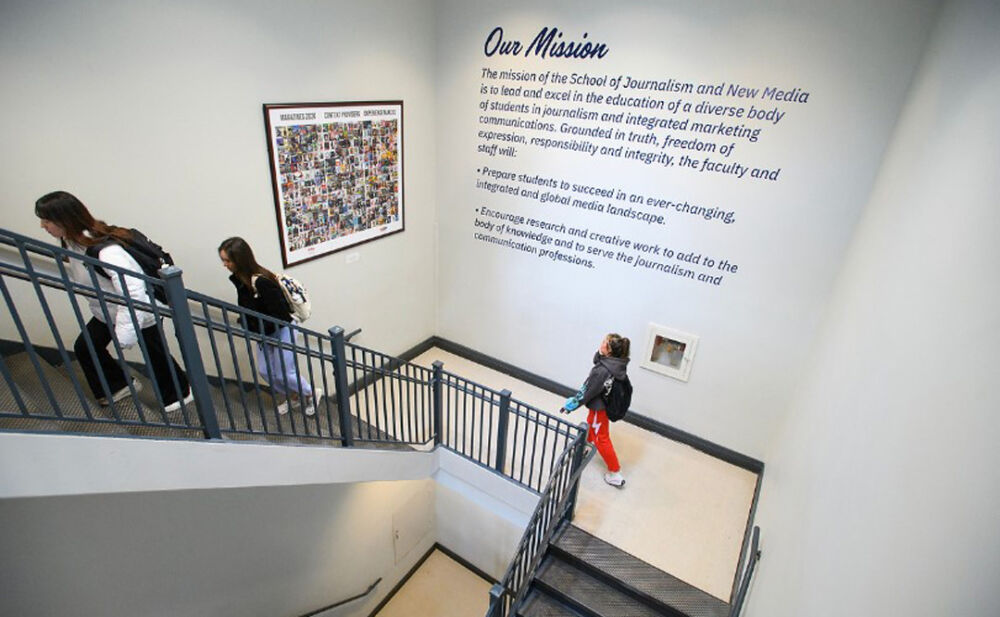
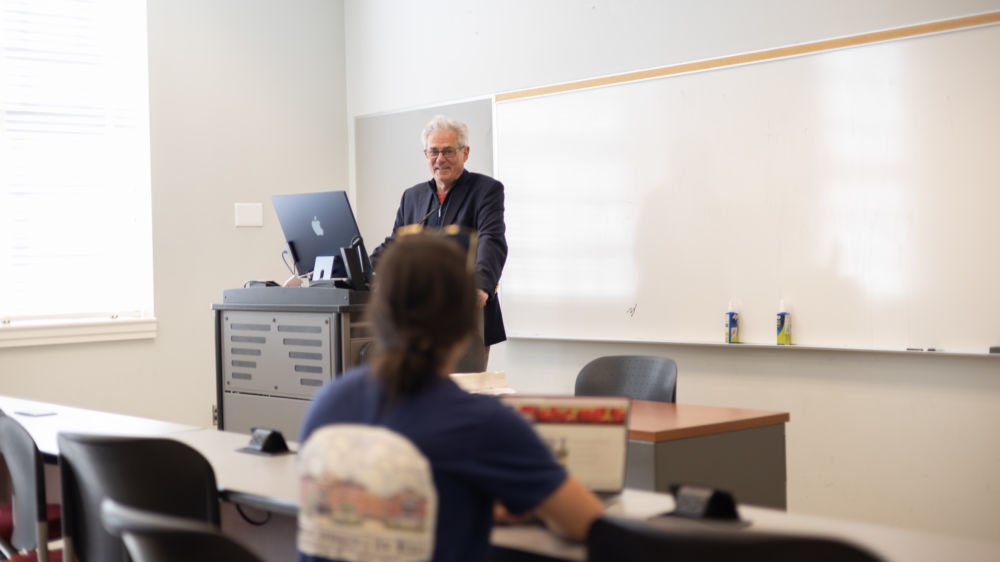
Home to the University of Mississippi’s School of Journalism is Farley Hall, a piece of University property with just as much history as Ole Miss itself. Situated on Grove Loop, directly across from the nine-acre Grove, Farley Hall and its location have served as a morgue in the Civil War, been visited by General U. S. Grant, and housed the School of Law. Today, Farley Hall houses the ever-improving and -expanding School of Journalism.
Built in 1929, Farley Hall is one of three buildings on the Ole Miss campus formerly known as Lamar Hall. The School of Law moved into the building in 1931 and there remained until 1978, when the new facility – the Law Center – was opened. The building experienced the first of many expansions in 1958, when a three-story extension was added onto the back of Lamar Hall. This expansion called for the destruction of the one thing for which Farley Hall is probably best known.
The historic marker that stands outside the building does not allow passersby to miss Farley Hall’s claim to fame. It reads, “Dead House.” The small, lead-lined building was originally constructed for use as a magnetic observatory, with intentions for the study of terrestrial magnetism and meteorology. The Civil War caused the building to neglect its purpose, reinventing it as a morgue after the Battle of Shiloh in April 1862. It is believed that 700 soldiers from both sides were carried across campus from this “Dead House” to the cemetery. But this location’s role did not stop there during the Civil War, as it was also used by General U. S. Grant in the fall of 1862 and by forces of General Nathan B. Forrest. Farley Hall’s expansion called for the destruction of this piece of history, and the addition was built in its place.
The building’s expansion and renovation was completed to house the University Archives blues collection, Music Library, Ole Miss yearbook staff, The Daily Mississippian and the Department of Journalism. Renovation brought not only a new face to the building but also a new name. In respect to three generations of Farleys associated with the law school, the name was changed from Lamar Hall to Farley Hall. Robert Joseph Farley was a member of the very first law class; Leonard J. Farley served as dean of the School of Law from 1912-1921; and Robert “Bob” Farley served as dean from 1946-1963.
Farley Hall found itself ready for yet another update 46 years later. In June 2005, construction began for the renovation of Farley Hall and for the addition of the Overby Center for Journalism and Southern Politics. In the fall of 2007, Farley Hall opened its doors to a new and improved home of the journalism department. The newly-renovated building greeted returning journalism students and the University as a whole with a 400-square-foot balcony overlooking the Grove, a 300-seat auditorium and “smart” classrooms – those equipped with computers, wireless internet and other necessary technology. Joining Farley Hall is the Overby Center for Journalism and Southern Politics, a new building offering a news wall of nine large-screen television monitors showing live news programs and current front pages from 12 Southern states. The Center offers 16,000 square feet of conference space, including a 225-seat auditorium, a conference room to accommodate up to 100 people, and a boardroom seating up to 24 people.