Ferris Awarded Frankel Prize
![]()
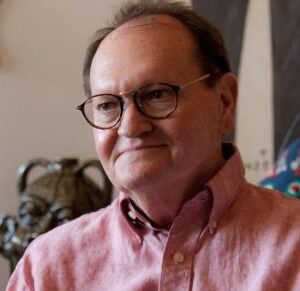
William Ferris, folklorist, filmmaker, photographer, and Director of the Center for the Study of Southern Culture, was awarded the prestigious Charles Frankel Prize in October for his work in the humanities. One of five Frankel Prize recipients in 1995, Ferris attended ceremonies on the south lawn of the White House where the President and First Lady honored 17 distinguished American artists and humanists for their outstanding contributions to the nation's cultural life.
"The stellar list of honorees includes some of the brightest beacons in American arts and culture," President Clinton observed. "These are the people who lift our spirits and illuminate our lives." The ceremony honored both artists and humanities as the President awarded the National Medal of Arts to 13 individuals along with the Frankel Prize.
Among the 1995 National Medal of Arts recipients was bluegrass musician Bill Monroe. In addition to Ferris, the 1995 Charles Frankel Prize recipients included Charles Kuralt, CBS correspondent and author; David McCaulay, author and illustrator; David McCullough, Pulitzer Prize-winning historian; and Bernice Johnson Reagon, performer, folklorist, and historian.
Picturing Home: Family Movies as Local History
A project of the Center for the Study of Southern Culture, "Picturing Home" collects home movie footage and the work of studio photographers in an effort to preserve the visual history of the region. Especially interesting are images of everyday life prior to 1950. Such images would include: cooking, farming, hunting, recreation, farm buildings, shops, industry, town scenes, sports, celebrations, schools, church activities, and political rallies. For more information, please contact Karen Glynn, Center for the Study of Southern Culture, 232-7811.
Remembered:
Mary Tillman Smith, 1904-1995
A native of Copiah County, Mississippi, Mary Tillman Smith began "making pictures" in the late 1970s or early 1980s.1 Often motivated by her religious faith and the desire to "pretty her yard," Smith transformed her approximately one acre home place into a fantastic art environment of painted tin, wood, and other found and recycled objects. She painted local figures on corrugated tin and mounted the portraits on her fence, her dog pen, or her son's garage. In the mid-1980s her vegetable garden included scarecrows made of tin, bicycle parts, paint can lids, and painted faces. Once collectors and art dealers located her yard on Highway 51 on the south side of Hazelhurst, her yard changed from a powerful and energetic art environment to a sparsely decorated yard. Smith attempted to keep up with the demand by painting quickly and replacing the bought art, but the buyers were ultimately too numerous.
An honest, unassuming woman who made friends easily and who wore her humility as a badge, she frequently shared her wisdom with visitors. A visitor to Mary T. Smith's yard might have heard her personal motto which she had carefully inscribed above her dog pen: "One face is all right, two face won't do."
The daughter of sharecroppers, Smith married first in 1922. In the 1930s, she married again, this time to John Smith. The couple then sharecropped near Martinsville, Mississippi. Her son, Sherdie Major, remembers that the Smith's were "run off in 1938 because she [Mary T. Smith] could do accounts and figured out that she was not fairly treated." In later years Smith did domestic work and gardened.
Smith's paintings have been widely collected and exhibited. Her many exhibition credits include "Baking in the Sun: Visionary Images from the South"(1987) and "Outside the Mainstream: Folk Art in Our Time"(1988) at the High Museum of Art in Atlanta.
1. This obituary was written with the help of two important sources: Sylvia and Warren Lowe, Baking In The Sun: Visionary Images from the South. Lafayette: University Art Museum, University of Southwestern Louisiana, 1987; and Chuck and Jan Rosenak, The Museum of American Folk Art Encyclopedia of 20th Century American Folk Art and Artists. New York: Abbeville, 1990.--TR
Photograph by Tom Rankin.
Loy Allen Bowlin, "The Original Rhinestone Cowboy," 1909-1995
Loy Bowlin, a self-taught artist who dubbed himself "the Original Rhinestone Cowboy" and created one of Mississippi's most distinctive folk environments, died at the age of 86 on June 14th in McComb. In the late 1970s, Bowlin was a familiar figure in McComb, playing his harmonica and buck dancing on street corners. He trimmed several western suits with braid, sequins and rhinestones, and decorated the dashboard and hood of his 1967 Cadillac with colorful rhinestones.
Eventually, Bowlin set about creating a home to reflect his identity, covering the walls and ceiling of his four-room frame house with his art. Christmas ornaments, family photographs, and images from advertising occasionally found their way into his work. But for the most part he created intricate designs on poster board using colored paper, glitter, fabric paint, and rhinestones. A sign over the front porch welcomed visitors to the "Beautiful Holy Jewel Home of the Original Rhinestone Cowboy."
Bowlin sometimes sold or gave away individual pieces of his environment and some of this work has been exhibited in galleries around the Southeast. However, he focused most of his creative energies on his home. "The Rhinestone Cowboy, with all his good humor and showmanship, created an environment that is at once powerful and fragile," says Debra Boykin, Folk Arts Program Director at the Mississippi Arts Commission. In 1992, a National Endowment for the Arts/Southern Arts Federation Regional Fellowship Panel recognized this power with a $5,000 fellowship award. Efforts are under way to preserve the house and its contents. Those interested in the preservation effort should contact Cassandra McGill, The Rhinestone Cowboy Museum Project, P.O. Box 7270, McComb, MS 39648, 601-249-2658.--TR