Southern Writer In Residence

Georgia Author Helps UM Students
Look Inward for Inspiration

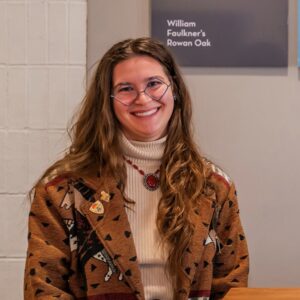
Georgia writer Mary Hood, the newest Southern Writer in Residence at the University of Mississippi
Photograph by Robert Jordan
Author Mary Hood considers herself just a working-class Jo.

She laughs when she recalls how on the first day of class a student, who was late and missed the introductions, asked who she was. Hood was anything but insulted.

"I thought that was great," the writer said with a beaming smile. "That meant that she was there to learn and not because of some celebrity, if I could even be called that."

The newest member of the University of Mississippi's Southern Writer in Residence Program, which is funded by bestselling author John Grisham and his wife, Renee', Hood does bring with her an expanding circle of admirers thanks to her latest work, the novel Familiar Heat. She offers not only an immense writing talent and grasp of storytelling but also a deep love for learning and teaching her craft.

When Hood talks about her students, the excitement can be heard in her voice and seen on her face.

"I know what they will and won't do," she said of the 16 writers who meet once a week for a couple of hours to hone their craft. They are relying on Hood's teaching style, a combination of textbook techniques and firsthand experience, to make them better writers.

Hood also takes pains to get to know her students. She carefully studies their weekly writing assignments and listens to their observations. One of her many in-class lessons involves looking at photographs or postcards and writing about the images, bringing life to the one dimensional objects. "It's like looking into their dreams. The eye connects to the heart."

When working with the Ole Miss students, Hood knows when to push and when to pull. She doesn't see it as her role to construct writers from raw materials. Instead, she hopes to simply highlight, reshape, define, and reaffirm.

"I like to know the ingredients. I try to figure out what type of writers they are and help them from that point," she said.

Hood's class, which she was given wide latitude to design, is titled "Writing as Profession, Trade and Craft: Why We Profess, What We Trade and Why We Craft." The author knows when not to take herself too seriously. Of the title she said, "I don't know why I came up with that; it must have been sunstroke."

But she does take very seriously the questions pondered in the class. Of the question "What We Trade?," Hood said she has asked her students to examine their attitudes toward writing, and then ask themselves what they hope to achieve: greatness, celebrity, or some other goal.

"I hope they have a sense of their own calling," she said of her students. Hood is fond of saying she has never taught writing but teaches writers, implying that such an act can't actually be taught. She knows from personal experience that one can learn.

Graduating from Georgia State University with a Spanish degree, Hood worked in sales, a language lab, and a library while writing in her spare time. She wrote without the benefit of editors, writing groups, and the like, and instead took her knowledge from the written word. "I owe everything I am to a library card and paperback books," she was quoted as saying in a Florida newspaper.

For the writer's five-month visit to Oxford, some of the most important items she brought from her home in Woodstock, Georgia, were boxes of books. Two floor-to-ceiling bookcases are stuffed with her collection and more boxes sit unopened on the floor. Every book waves slips of paper marking important passages she may use later in class.

While teaching at Ole Miss, Hood also is conducting occasional readings. Somewhere between teaching and hitting the road for book-signing events, she hopes to take advantage of her time in Oxford to work on her third collection of short stories. Her previous collections, How Far She Went and And Venus Is Blue, received both critical and popular praise.

Tentatively called Survival, Evasion, and Escape, the title of her new collection comes from a U.S. Army training manual. Hood saw the book in a catalog and soon ordered it. Like the many books in her bookcase, the manual is dog-eared and highlighted. Even in a bland training manual Hood finds inspiration. "I have always liked to know how to live off the land," she said, noting that the title's meaning can be stretched to imply other attempts of survival, evasion, and escape in everyday lives. Those themes will run throughout the stories.

As Hood now begins to enjoy the fruits of her years of labor, she hasn't fully made the adjustment although parts of her notoriety are getting easier.

"Being here has been, well, embarrassing," she said. "It feels odd to be granted this lovely house and a stipend out of the blue; I just love that word 'stipend.' It sounds ordinary but it is an elegant concept. In Latin it means gold paid out against a counterweight in this case, my work, my writings. Who wouldn't be overwhelmed and grateful?"

Christopher Sheffield