A Conversation with
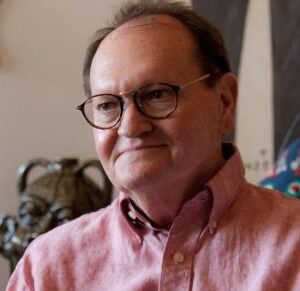
Elzbieta Oleksy

In 1989 a revolutionary event swept over Poland. For the first time in history, a Communist regime was peacefully ousted, with labor leader Lech Walesa leading the charge.

Since that time, Elzbieta Oleksy has lead a revolution of her own by organizing the first women's studies program in the Central European nation. It is a novel idea whose time has finally come in Poland, land of fervent Catholicism and traditional family roles.

"At the beginning, our people were sort of reluctant to accept it," says Oleksy, a visiting scholar attracted to Oxford by the Center for the Study of Southern Culture. Some people felt the Women's Studies Center at the University of Lodz was, well, a bit radical. In fact, says Oleksy, "I don't know of any radical feminists in Poland."

Women and their role in society, literature, and film is but the latest passion in Oleksy's energetic career. A prolific writer and well-traveled lecturer, she has taught American culture, literature, and film at the university in Lodz--Poland's second-largest city. She also was a visiting professor at the University of Pittsburgh and Southern Seminary Junior College (now Southern Virginia College), a predominantly women's school.

Currently, in addition to her duties as a professor at the University of Lodz, she wears several administrative caps, directing both the women's center and the North American Studies Center, plus serving as academic dean of university's Faculty of International Studies.

With such a burdensome load, Oleksy says she is thrilled to be here, deep in research in the Deep South. "This is such a treat," she says.

In Oxford since February 15, Oleksy is working on a book exploring "women's bonding in contemporary Southern fiction and films." She is still mulling the title, but is considering Buddies, she says with a smile. The book will have three parts: bonding among black women, bonding among white women, and bonding across racial lines. She is tapping such disparate sources as Willa Cather's Sapphira and the Slave Girl and the papers of the United Daughters of the Confederacy.

The book will embody a relative new technique Oleksy has been using lately in her teaching--the comparative coupling of literature and film. She and her students in Poland have considered, for example, friendships of black and white women in Passion Fish and the Ellen Douglas novel Can't Quit You, Baby, and the beauty parlor banter of Steel Magnolias and Eudora Welty's short story "Petrified Man."

A frequent visitor to the United States, Oleksy earlier was a serious student of Walker Percy, even devoting a chapter to the Catholic writer in her dissertation on postmodern American novels. A highlight for her came in April 1984, during a visit to Louisiana State University. She managed to get a daylong interview with Percy at his home in Covington, Louisiana. That interview eventually was published (More Conversations with Walker Percy, ed. Lewis A. Lawson and Victor A. Kramer, University Press of Mississippi, 1993) and Oleksy corresponded with Percy until his death in 1990.

Why her interest in the South? Oleksy says she sees a lot of kinship between the region and Poland, especially where women are concerned. "I think the South is a fairly traditional society still," she says.

Oleksy is quick to qualify that a traditional society can be the object of ridicule, but it also can be valued. Consider Poland, where life for women is a study in paradox, she says. They value their freedom, but also yearn for the traditional family life. They rarely have much voice in the heavy stuff of politics or economics and still revel in traditions like hand-kissing, yet most Polish women would say they enjoy good standing compared to women in other places.

Of course, women under Communism were constitutionally equal to men, which in reality was "rubbish," Oleksy says.

Lately, Polish women have gained a higher profile globally, in part thanks to Oleksy. In 1995 she guest edited a special issue of Women's Studies International Forum devoted entirely to Polish women in all aspects of life.

Oleksy, for one, has struck an impressive balance of career and family. At age 50 she has traveled widely and excelled as a scholar, and also raised a son with her linguist husband, Wieslaw Oleksy.

These days, Poland is undergoing considerable political upheaval, in a way coming full circle from the "bloodless revolution" of 1989, Oleksy says. Although Poland is doing well economically--Business Week recently tagged it the "rising star of Europe"-- repackaged Communists nevertheless have managed to retake the government. Sweeping change, of course, is not unusual for this New Mexico-sized nation, through history a frequent victim of conquest, partition and control at the hands of its powerful neighbors.

For you students of Polish life, let it be known that Oleksy--whose name is uncommon in Poland--is not related to former Prime Minister Jozef Oleksy, now facing accusations that he was a spy for the Soviet KGB.

Come what may back home, Oleksy is enjoying her latest foray into America, its letters and films. She plans to stay in Oxford through the Spring Semester, and maybe longer. Her visit is sponsored by a Polish-American foundation, but a Fulbright scholarship will fund a further year's stay in the United States beginning in August.

Wesley Loy

Photograph by Wesley Loy