Being
recognized by Food and Wine magazine as one of
the "most fearsome talents" in today's
food world is "more incentive to keep going,"
says Amy Evans, associate director of the Southern
Foodways Alliance Oral History Initiative. A recipient
of the magazine's 2004 Tastemaker Awards, Evans
is featured in the November issue of Food and
Wine with 34 other "fabulously creative people,"
which is how senior editor Kate Krader describes
those included on the list.
The
wide-ranging list of "tastemakers,"
all of whom are 35 years old or younger, is one
that includes gardeners, vodka makers, environmentalists,
food scholars, and chocolatiers. Evans was included,
according to Krader, because of her strong belief
in what she's doing and because of the scope of
SFA's Oral History Initiative. "Her work
is incredibly important, since tradition can die
out with one person," Krader says.
The
goal of Evans's work, according to the SFA Web
site, is to "document the life stories of
unsung tradition bearers of the food arts."
She is no doubt succeeding. Currently available
on the SFA site (www.southernfoodways.com) are
photographs, biographical essays, and some 40
transcripts of interviews dedicated to the Greek
food traditions of Birmingham, Alabama; contemporary
eateries of Greenwood, Mississippi; historical
eateries of Oxford, Mississippi; and barbecue
of Tennessee. "Most oral histories end up
in a filing cabinet," says SFA director John
T. Edge. "But we wanted to embrace the possibilities
of the Internet. On the SFA Web site, you can
get a summary of an interview, an edited transcript
or the full transcript of an interview in a PDF
file."
The
site also provides information on how those interested
in preserving Southern food traditions can participate
in the Oral History Initiative as interviewers,
which Edge and Evans encourage, of course. For
folks willing to "dig in their own backyards,"
SFA offers tips on equipment, labeling, conducting
interviews, transcribing, and submitting completed
oral histories and photographs to SFA. "The
call always exists for volunteers to conduct oral
histories," Evans says. "When you do
this, you're creating a historical document that
can then be shared with so many people."
And
that, of course, is a primary goal of studying
Southern foodways and Southern culture in general.
"Amy's work is a great example of how what
we teach in Southern Studies can be applied to
issues in the real world," Edge says. "Her
being recognized by Food and Wine is both apt
and also a tribute to the work of SFA and the
people who come to the University of Mississippi
to take part in the Southern Studies master's
program."
Evans, a native of Houston, Texas, received a
bachelor's degree in printmaking from the Maryland
Institute College of Art before relocating to
Oxford, where she earned a master's degree in
Southern Studies from the University. An exhibiting
artist, freelance photographer, art educator,
and cofounder of PieceWorks, the Oxford-based
nonprofit arts and outreach organization, Evans
also works as a special project consultant for
Greenwood's Viking Range Corp. And in fact, the
work she did through a grant from Viking to document
the stories of those responsible for Greenwood's
rich culinary landscape was featured in the June
2004 issue of Travel + Leisure magazine. "We're
getting the word out," Evans says. "It's
wonderful that people are recognizing the value
of preserving our culture through oral histories."
As
for the future of the Oral History Initiative,
Edge says that he and Evans are "really looking
to expand" now. "We started with barbecue
and hit our stride with the Greenwood project
with the help of Viking, then Jim 'N Nick's (a
Birmingham-based collection of barbecue restaurants)
pledged $75,000 to fund oral histories for the
next five years."
Stories
concerning barbecue in the Carolinas and baking
in Georgia will appear on the SFA Web site within
the next few months, Edge says. And Evans says
other short-term goals include publishing printed
material specific to the oral histories already
produced--such as a bound volume of excerpts from
the histories--and conducting new oral histories
in conjunction with annual fall SFA symposiums,
which are themed (next year's symposium will address
sugar and Louisiana, for example). Evans is also
planning interviews with SFA's 50 founding members.
"What Amy is doing matters far beyond an
oral history being stored in some filing cabinet,"
Edge says. "She's doing the job of capturing
people's life stories."
Jennifer
Southall

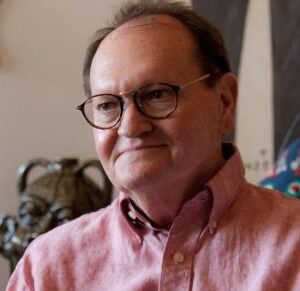
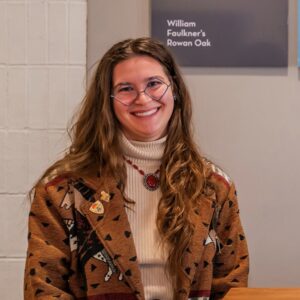
Amy Evans
photo by Kurt Streeter