Spring 2008


1

Director's Column


Academics, especially those of us in the humanities, are not trained to work with other people. With a few exceptions, professors in the humanities are trained to work on our own, to research quietly, to sit in silent rooms hoping for some inspiration that will allow us to make sense of that research. No matter what I do, I will always be, among other things, the young person staying up late in the dorm agonizing over sentences, then paragraphs, then entire papers. That experience prepares us to do many things, but it does little to train us to work with other people.


The Center tends to thrive on collaborations, including some that are new and promising. As we faculty members wrap up what I think of as the Professor’s Spring Triathlon—first thesis and dissertation defense season, followed by final exams, all of which is quickly followed by a weekend of graduation ceremonies—it may be helpful to think about new collaborations at the Center for the Study of Southern Culture.


In one collaboration, folks from Living Blues and the Southern Foodways Alliance spent time in Chicago for events in late May. Called Camp Chicago: An Up South Expedition, the event discussed food and music and how both have traveled. This event was held in connection to Living Blues magazine’s conference entitled “Blues and the Spirit: A Symposium on the Legacy of the Blues and Gospel Music.” The Southern Foodways Alliance collaborated with the Midwestern Foodways Alliance and the LTHForum, a Chicago-based culinary chat site.

Another collaboration combines the efforts of Documentary Studies Director David Wharton here at the Center, the Gertrude Ford Center for the Performing Arts and the American Music Archive project, and the Library of Congress. For the second year, David and representatives of the Library of Congress are teaching a summer class on how to document musical traditions. Last year, this class taught several students about the intellectual, ethical, and technical issues involved in documenting a range of musical traditions. This year the class is concentrating on traditions in Southern religious music.


David Wharton team-taught a class this spring with Andy Harper (and also Southern Studies alumnus Joe York) on the making of documentary films. Harper and York work in the Center for Documentary Projects, and the project again benefited from the American Music Archive project. A number of the students made films for the first time.


In July, Charles Reagan Wilson, as part of a program organized through the Trent Lott Leadership Institute, will teach a class that brings together students in Mississippi, Northern Ireland, and South Africa to study religion and reconciliation efforts in those three places.


A collaborative project that is finally coming to an end is the Mississippi Encyclopedia project. A book we started in back in 2003, in response to even earlier suggestions from the University Press of Mississippi, is wrapping up this summer, and we hope to get it to the Press in time for publication in 2009. That book is a collaboration among many groups, including the Center, the University Press of Mississippi, the Mississippi Humanities Council, the Mississippi Arts Commission, the Mississippi Department of Archives and History, the Law School, the History Department, the College of Liberal Arts, and the Chancellor’s office.

When the Mississippi Encyclopedia finally goes away to the Press, we will celebrate, sleep late for a day or two, and then start imagining other possible collaborations. Every few months, we cheer with Charles Wilson and Jimmy Thomas when yet another volume of The New Encyclopedia of Southern Culture goes to off to press and comes back as a book. The Literature and the Law and Politics volumes are new and on the shelves, and others, like the Gender volume that I coedited with Nancy Bercaw—another collaboration—are on the way.


The quality of our students remains high, and this year, as it seems to do every year, Southern Studies graduated more MA students than it has faculty members. The graduate program itself relies on collaborations, both with thesis committees consisting of Southern Studies core faculty and associate faculty, and with the program benefiting from assistantships provided by the Southern Foodways Alliance, Living Blues, the William Winter Institute for Racial Reconciliation, the Center for Documentary Projects, the Gertrude Ford Center for the Performing Arts, and this past year, Thacker Mountain Radio and the University Museums.


Since last spring, ten MA students have completed the program, seven by writing theses and three by completing internships. I always find the range of interests among our students amazing, and in truth it is a pleasure to deal with so many topics. In the past year, Southern Studies MA students have written on the idea of a male military tradition in Southern fiction, the Lebanese American experience in the Mississippi Delta, the life of food author Craig Claiborne, literature and identity in New Orleans, the interconnected issues of violence, commemoration, and racial reconciliation, prohibition and temperance in Mississippi and Arkansas, the private school movement in the Mississippi Delta, and Carolina mill workers in an age of globalization. Three students completed internships. It is hard to discuss graduation without using the sort of clichés we tell students not to use in their theses, but we hate to see them go.

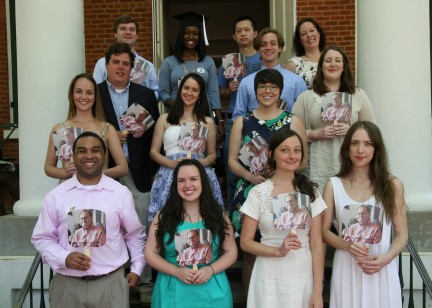
Three Southern Studies undergraduate majors or double majors have graduated in the past year, and I was happy to see the graduates, both BA and MA, gathering with their families and friends at a lunch event on graduation day. One of the more successful assignments in the 100-level courses in recent years is a project in which teams of 6 to 8 students work together to study a group or publication that is important to the contemporary South. This year those group presentations involved multiple media and dramatic presentations as part of their discussions. Projects in several classes require group work, so I am happy to say that our students have in fact been learning skills of collaboration that I, tucked away avoiding passive voice in my dorm rooms and library carrels, never learned in college.


TED OWNBY


Center for the Study of Southern Culture