BACHELOR OF ARTS
SOCIAL SCIENCE REQUIREMENT: 6 hours
[Economics] [Political Science] [Psychology] [Sociology and Anthropology]
DEPARTMENT OF ECONOMICS
Any economics course will fulfill this requirement. Detailed below are the freshman and sophomore-level courses.
ECON 101. INTRODUCTION TO ECONOMICS
This course is a primer for students who wish to have basic economic literacy, understand different economic concepts and policies, and develop critical thinking skills. Economics is not primarily a set of answers, but rather a method of reasoning. By the end of the semester, students should be able to use the analysis practiced in the course to form their own judgments about major economic problems faced by the United States and other countries. General goals of the course include: to help students understand various ways of thinking about economic phenomena; to make students more careful, critical, and thoughtful readers; to assist students in developing a personal philosophy of life.
ECON 202. PRINCIPLES OF MICROECONOMICS
This sophomore-level course uses analytical and historical analysis to model the behavior of the two basic elements of a market economy: consumers, who are the underlying origin of market demand, and producers, who are the underlying origin of market supply. The individual consumer is modeled as an agent with preferences (likes and dislikes) who makes herself as well off as possible given her income, prices and the available choices of economic goods. The individual firm is modeled as an entity with production capacity that turns inputs into output, and output into profit. Firms operate in a variety of environments, ranging from competitive to monopolistic. As consumers try to attain their most preferred outcomes and firms try to maximize profits, their interaction within the economic institutions of the price system determine market outcomes, the production of goods and services and the distribution of income. This course analyzes the predictions of the analytical models and their relevance to society. The course also addresses the role of government policy both as an economic agent and the custodian of society’s goals and priorities.
ECON 203. PRINCIPLES OF MACROECONOMICS
This sophomore-level course requires Econ 202 as a prerequisite. The course focuses on the nature of economic activity at the national and international level as opposed to individual consumers and producers. Topics include the resources and the goals of the economy, and the role of government in achieving those goals. Students are introduced to national income accounting (how Gross Domestic Product is calculated) and economic issues like unemployment and economic growth. The course also discusses the basics of the monetary system in a market-based economy, which includes banking and financial institutions and the role of a central bank like the U.S. Federal Reserve system in determining monetary policy. Monetary policy includes control of the money supply and interest rates. The government’s taxation and spending policy, or fiscal policy, and its effects on the economy are also analyzed.
DEPARTMENT OF POLITICAL SCIENCE
Any political science course will fulfill this requirement. Below are the three introductory courses to the sub-fields of the discipline.
POL 101. INTRODUCTION TO AMERICAN POLITICS
The primary purpose of this course is to introduce the dynamics of American national government and policies. Students will better understand our political system in several different and important ways: as a set of primary and underlying values; as a series of governing principles; as processes in which forces compete; as separate institutions with powers and limitations; and, as a framework for human behavior and interactions. In addition, this course helps students refine their analytical and expressive skills. Simply put, the need to enhance citizens’ abilities to think critically, speak intelligently, and write clearly is a top priority in today’s world. If we as citizens are to participate in and contribute to our political society, we must be able to do three things well with new information and ideas: test their assumptions, assess their value, and then voice our educated opinions.
POL 102. INTRODUCTION TO COMPARATIVE POLITICS
This course allows students to understand the political system of different countries around the world. Students will investigate the politics of certain countries from across the globe, including long-established democracies, transitional or new democracies, and authoritarian countries. Students will investigate topics that may include presidential and parliamentary systems, different kinds of electoral systems, political parties, interest group representation, communism, transitions to democracy, rule of law, political culture, and economic development. The comparative aspect of this field is the search for similarities and differences between cases in order to formulate theories and hypotheses about politics. By the end of the semester, students will be more informed about the political world outside of the United States of America and will have increased knowledge and understanding of important concepts and theories in comparative politics. Finally, the course will sharpen students’ reasoning skills by encouraging them to be more rigorous about how they think about politics and communicate their ideas.
POL 103. INTRODUCTION TO INTERNATIONAL RELATIONS
This course is designed as a broad introduction to the theories and ideas contained within the field of international relations, the study of global issues such as international security and international political economy. Topics include military conflict, concepts of power, cooperation, international organizations, economic sanctions, international trade and financial activities, population growth, and the environment. The goals of this course are to get students to think systematically about the processes of international relations, and ultimately to help students formulate their own informed opinions about world politics.
DEPARTMENT OF PSYCHOLOGY
Any course in the department will fulfill this requirement. Below is the introductory course.
PSY 201. GENERAL PSYCHOLOGY
This course is a survey of the major areas in the field of psychology, the scientific study of behavior. The following areas are emphasized: major models of psychology, research methods used in psychology, social psychology, the organization of the human brain and the biological bases of behavior, principles of learning, major theories of personality development, the concept of intelligence, psychological development during the lifespan, and classification of abnormal behavior and mental illness. The terminology, principles, processes, and methods in the above areas will be discussed.
DEPARTMENT OF SOCIOLOGY AND ANTHROPOLOGY
Any anthropology or sociology course will meet this requirement. Below are the introductory courses, which do not have a prerequisite and are appropriate courses for non-majors to fulfill the social science requirement.
ANTH 101. INTRODUCTORY CULTURAL ANTHROPOLOGY
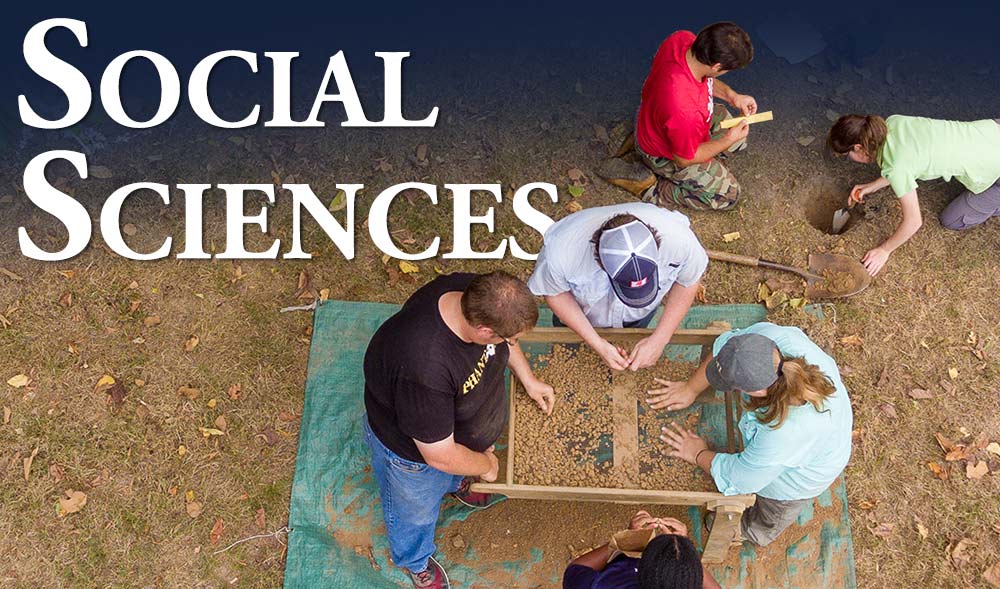
Anthropology is the holistic study of human life throughout time and across the world. This course focuses on the cultural characteristics of human groups that are examined through ethnology, linguistic anthropology, and related subfields. Students will be introduced to central concepts of anthropology, including culture, adaptation, and enculturation. The capacity to create and sustain cultural systems is unique to humans; culture is essential to human adaptation to physical, social, and psychological environments. Culture provides people with the means to organize themselves into protective and productive groups, and it allows these groups to overcome a great variety of problems that can result from interactions among group members with distinct personalities. In this course, students will examine how culture can account for the great variety of practices and beliefs that exist throughout the world, and outline the strategies that anthropologists use to understand human variability.
ANTH 102. INTRODUCTORY ARCHAEOLOGY AND BIOLOGICAL ANTHROPOLOGY
This course focuses on introducing students to archaeology and bioanthropology, two of the four subfields of anthropology, by presenting a broad overview of the methods and concepts used to study the development of cultural and biological variation among human groups over time. In addition, the course focuses heavily on the scientific aspects of these subfields by explaining the logic behind interpretations of data. The first portion of the class will cover aspects of variation found in humans and non-human primates. The second portion will cover the evolution of Homo sapiens beginning with the appearance of the first primates 55 million years ago. The final portion of the course will review archaeological evidence for the rise of civilization.
SOC 101. INTRODUCTORY SOCIOLOGY I
Sociology is the scientific study of human social behavior. SOC 101 provides an introduction to the basic sociological concepts and research methods sociologists use to examine the social world. A major objective of the course is to teach students to utilize theory and empirical research so that they can analyze society from new viewpoints and better understand how individuals are shaped by powerful social forces. The course explores how groups create meaning through everyday interaction, how power functions in important social institutions such as the economy, politics, education, and the family, how systems of inequality are maintained and resisted, and how social change occurs.