
Research in the laboratory focuses on the ecological and evolutionary consequences of interactions among species, including mutualism, parasitism, and competition. We use lab experiments, field studies, modeling, and meta-analysis to address research questions. Our empirical work encompasses diverse systems, ranging from interactions between trees and symbiotic ectomycorrhizal fungi to vertebrate animals in temporary agricultural wetlands. You can find a list of our publications HERE.
Ongoing projects fall under several broad questions:
How do mycorrhizal fungi mediate vegetation responses to global change?
-
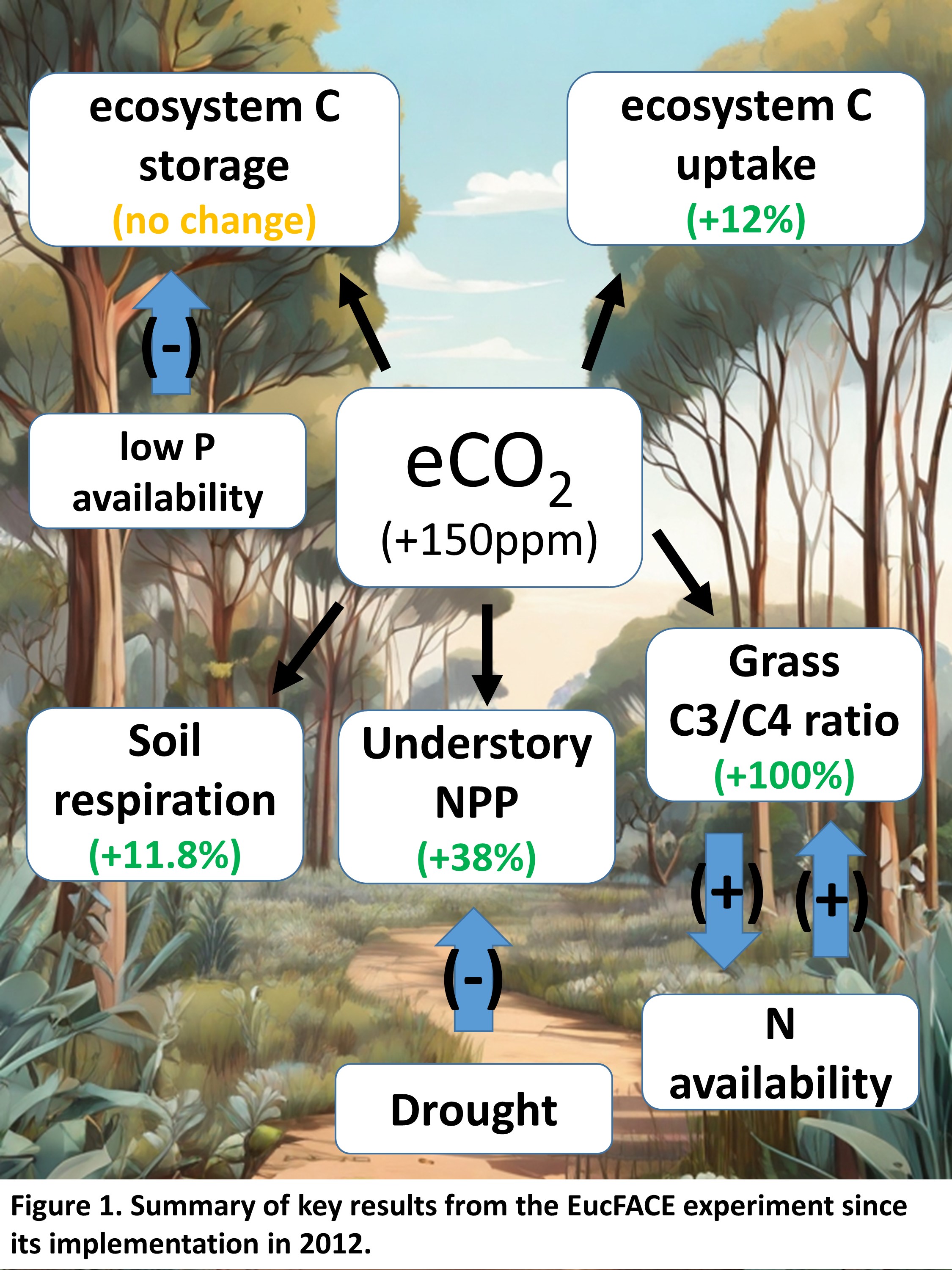
Free-air CO2 enrichment (FACE) research in dryland, infertile subtropical forests has found significant contrasting effects of CO2 enrichment (eCO2) relative to temperate zones. Specifically, eCO2 has not led to an increase in net primary productivity, but rather to increases in soil respiration and shifts in the understory plant community to specific (C3) grasses dominating. Such C3 grass invasion can have negative ramifications for important ecosystem functions such as water and nutrient cycling, but the mechanisms by which understory plant communities change under changing climate conditions are unknown, thus limiting our ability to predict which current day ecosystems may be most at risk. In a DOE-funded project, our team of US and Australian collaborators is testing the overarching hypothesis that a shift to increasing relative dominance of C3 grasses under eCO2 is accompanied by shifts in the composition and traits of critical root symbiotic fungi, resulting in reduced C storage in soil. We are testing that hypothesis with a combination of three approaches: (a) Field ‘omics and biogeochemistry, measuring soil, microbial, and plant biogeochemical cycling (C, N, and P pools and fluxes) as well as plant and fungal gene expression in roots and soils at EucFACE, (b) Controlled-environment Experimentation, using growth-chamber experimentation with soil from EucFACE to test the interactive effects of eCO2 and understory vegetation on morphological and molecular traits of mycorrhizal fungi, and association of those traits with the performance of key C3 and C4 grasses; and (c) Ecosystem Modeling to leverage our observational and experimental data to improve the ability of a plant-microbial interactions model (FUN-CORPSE) to predict the impacts of eCO2 on understory vegetation shifts, and shifts in fungal traits on coupled C-N-P cycling in forests. Read more in this press release by the University of Mississippi.
What are the community, ecosystem, and evolutionary consequences of coupled plant-fungal invasions?
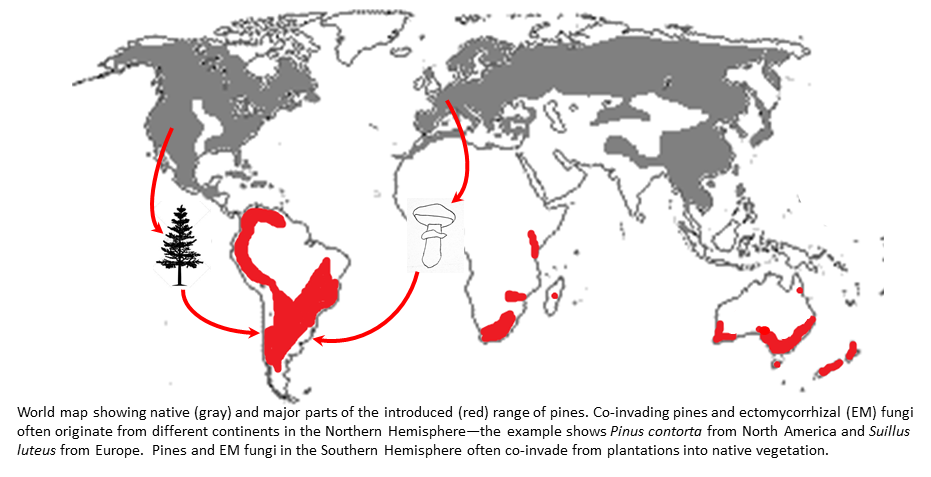
- As human activities increasingly alter the relative dominance and distributions of biotic communities through introductions and management, major geographical shifts are occurring in plants and plant-associated soil microbial communities, resulting in new plant-microbe assemblages in exotic environments. These novel assemblages can provide exciting opportunities to answer integrative questions on the eco-evolutionary dynamics of biotic redistributions, and their consequences for biodiversity and ecosystem functions, as articulated in our review paper in Frontiers in Forests & Global Change (Hoeksema et al. 2020). 300 years of pine introductions into the Southern Hemisphere have been accompanied by co-introduction of associated microbial communities, particularly obligate symbiotic ectomycorrhizal (EM) fungi, which thrive in exotic pine habitats but are often much less diverse than in native pine habitats. Moreover, pines often invade into nearby habitats and are accompanied by an even less diverse (but see this paper in Fungal Ecology for an exception: Milani et al. 2022), but still thriving, suite of co-invading exotic EM fungi. Both pines and EM fungi can have dramatic effects on biodiversity and ecosystem function, and the repeated introduction of different pine hosts and EM fungal symbionts into a diversity of exotic environments in the Southern Hemisphere can be viewed as an opportunity: a powerful natural experiment for asking how introduced host-symbiont assemblages affect community and ecosystem functions, and how members of diverse assemblages evolve across a geographic mosaic of abiotic and biotic environmental factors. Pursuing these questions has sparked collaboration with a diverse group of colleagues including Steve Brewer (here at UM), Rytas Vilgalys, Brenda & Mike Wingfield, Anne Pringle, Francois Teste, Tomas Milani, Laszlo Nagy, Erika Buscardo, Sunny Liao, KoKo Chen, Jenny Bhatnagar, Colin Averill, Alejandro Rojas, Eddie Brzostek, Nahuel Policelli, Mark Anthony, and others. A current NSF IRES grant (Award #1953299) is supporting graduate research experience pursuing these questions in both South Africa and Australia (read more here).
How do ecological context and evolutionary history influence the outcomes of mycorrhizal symbiosis?
-
To address this question, we are using phylogenetic meta-analysis of a large database of experiments measuring plant growth responses to mycorrhizal fungi. This work has been conducted as part of a long-standing collaboration with numerous individuals (read about the history of this collaboration here). One product of this collaboration is the MycoDB database (Chaudhary et al. 2010, 2016), in which we have compiled the results of hundreds of experiments in which plants were inoculated with mycorrhizal fungi. The database is being used in a series of meta-analyses (Hoeksema et al. 2010, Rúa et al. 2016 & 2018, Hoeksema et al. 2018), with the goal of better predicting ecological outcomes in the mycorrhizal symbiosis. Conducting these analyses has required developing novel tools and methods, including substantial additions to the R package metafor, written by our collaborator Dr. Wolfgang Viechtbauer, as well as new approaches to using model selection on mixed models in a meta-analysis context (Cinar et al. 2021). Our most recent analyses suggest an important role for evolutionary history in predicting cotemporary outcomes of mycorrhizal interactions. Ongoing work will aim to better characterize that evolutionary history, including the potential role of natural selection, and to more deeply model the influences of important contextual factors like light and soil nutrient availability, so that we can understand the balance between ecological context and evolutionary history.
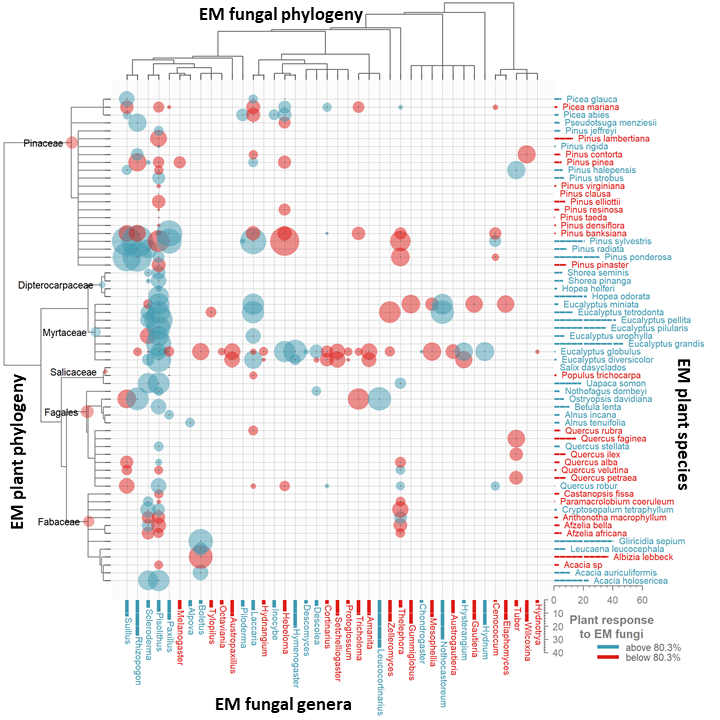
Figure 1 from Hoeksema et al. 2018, illustrating the effect of plant and fungal phylogeny on the average magnitude of plant growth response to mycorrhizal fungi.
Can purposeful flooding in crop fields be used to restore temporary wetland function, benefiting migratory birds, conserving soil, reducing pollution, and improving crop yields?
-
It sounds too good to be true, but our data from a 2-year study at a farm in the heart of the Mississippi Delta suggest exactly that. The conservation non-profit Delta Wind Birds began working in 2018 with a crop farmer to explore whether high-quality stopover habitat for migratory shorebirds could be created after fall harvest on corn fields using leftover surface water from a tailwater recovery reservoir. Responses of migratory shorebirds were immediate and impressive. Subsequent collaborations with Dr. Jason Taylor at the USDA National Sedimentation Laboratory showed that these "pop-up wetlands" significantly reduce soil sediment runoff from fields while also promoting beneficial microbial denitrification, which reduces downstream nitrogen pollution. Most encouragingly, subsequent soybean crops on these flooded corn fields exhibited ~5% improved yield, compared to previously unflooded fields. See here for a feature story about our work on that farm, in Living Bird Magazine from the Cornell Laboratory of Ornithology, and here for a summary from the USDA. A current grant from the EPA's Gulf of Mexico Farmer to Farmer program is allowing us to test whether these results are consistent among multiple farms, how they depend on the timing of flooding (fall vs. winter) and the crop cycle (after corn vs. soybeans), and what aspect of soil biogeochemistry may be responsible for effects on crop yield. Our non-profit partner Delta Wind Birds is teaming up with the USGS to radio-tag shorebirds stopping at these sites, to estimate how long individual birds are staying.
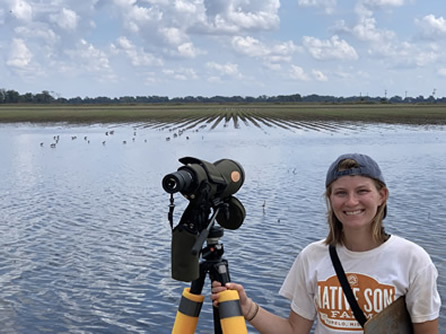
Emma Counce, a Master's student in the lab, surveying migrating shorebirds on a pop-up wetland at a farm in Sunflower County, Mississippi.
How do mycorrhizal fungi influence plant-plant interactions?
-
The potential role of mycorrhizal networks in forests has captured the imagination of a broad popular audience, with stories of their benefits to trees reaching into best-selling books, high-profile newspapers, radio and podcasts, TV series, and Hollywood films. Indeed, some results from our own field experiments have supported the idea that access to mycorrhizal networks associated with adult trees can substantially enhance survival of tree seedlings (Booth and Hoeksema 2010). However, the evidence from more than 2 decades of experiments makes it clear that the story is not so simple--mycorrhizal networks are often not beneficial, are highly context-dependent, and are often offset by negative root-root interactions among trees. Moreover, experimental tests of these phenomena are fraught with methodological challenges that necessitate consideration of alternative interpretations (Hoeksema 2015, Karst et al. 2023; webinars by Jason: 1, 2). Indeed, we recently analyzed relevant field studies and found little or no empirical support for the most common claims being made about the effects of common mycorrhizal networks on trees in forests, and evidence for positive citation bias on that topic in the scientific literature (Karst et al. 2023). Current work in the lab is applying improved experimental designs in field studies to separately quantify the diverse pathways (roots, soil, and fungal networks) through which trees may interact, using laboratory experiments to quantify the context-dependency of the tree-fungal interaction (Horning et al. 2022) while testing economic models of mutualism (Schwartz & Hoeksema 1998, Hoeksema & Schwartz 2003), using mathematical models to test alternate hypotheses on the importance of fungal networks for plant ecology, and applying research synthesis to quantify effect sizes and biases across the full set of currently published studies. Outreach associated with this project includes teaching local high school students about soil ecology, and helping the conduct an experiment on the importance of soil microbes for plants (see some photos here).
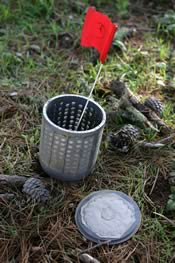
Mycorrhizal networking cylinder used in field experiments to estimate effects of mycorrhizal networks on plant-plant interactions
How do diverse mutualisms coevolve?
- The geographic mosaic theory of coevolution predicts that geographically variable coevolutionary selection is important for trait diversification, but robust tests of this prediction are rare in diverse mutualisms. When there are numerous species on one or both sides of an interaction, does coevolution still drive trait evolution, or is selection from abiotic sources more important? Mycorrhizal symbioses are well suited for answering this question (Hoeksema 2010), and one set of projects in our lab has focused especially on estimating genetic variability and trait diversification in interactions between diverse communities of ectomycorrhizal fungi and pines (Hoeksema & Thompson 2007, Piculell et al. 2008, Hoeksema et al. 2009, Hoeksema et al. 2012).
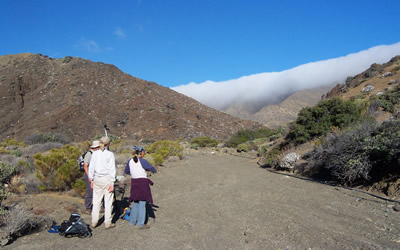
Expedition to Cedros Island, Mexico to collect seeds and soil (containing resistant propagules of ectomycorrhizal fungi) from native Monterey pine (Pinus radiata) forest.
Bridget Piculell's PhD research, in collaboration with Dana Nelson (USDA), used the interactions between loblolly pine (Pinus taeda) and its ectomycorrhizal fungi to understand the genetic basis of "mycorrhizal traits" in plants including their heritability (manuscript in preparation), underlying candidate genes (Piculell et al. 2019), and how correlations with other pine traits such as disease resistance (Piculell et al. 2018) may influence responses to selection. Ongoing collaborative work with Megan Rua is directly estimating natural selection on traits of the interaction between Monterey pine (Pinus radiata) and its ectomycorrhizal fungi, using results from common garden experiments at field sites in coastal California.
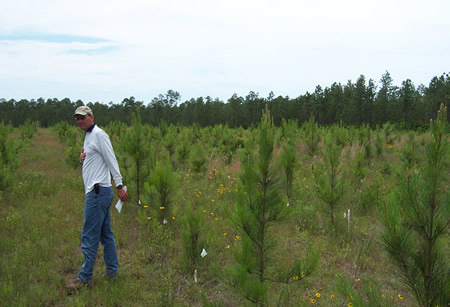
Dana Nelson in a common garden of loblolly pine (Pinus taeda) clones near the USDA Southern Institute of Forest Genetics in Saucier, Mississippi.